Inhaltsverzeichnis
Able Hardware builds custom industrial carts to print in Suzhou, Jiangsu, China shipping them welded, fitted, finished and packed.
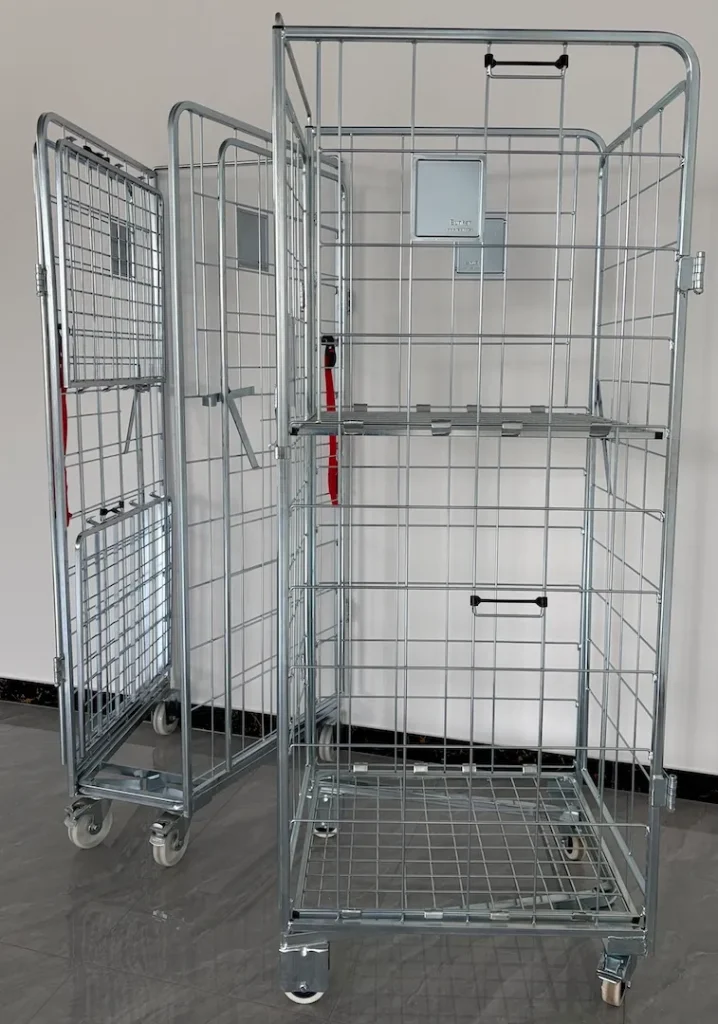
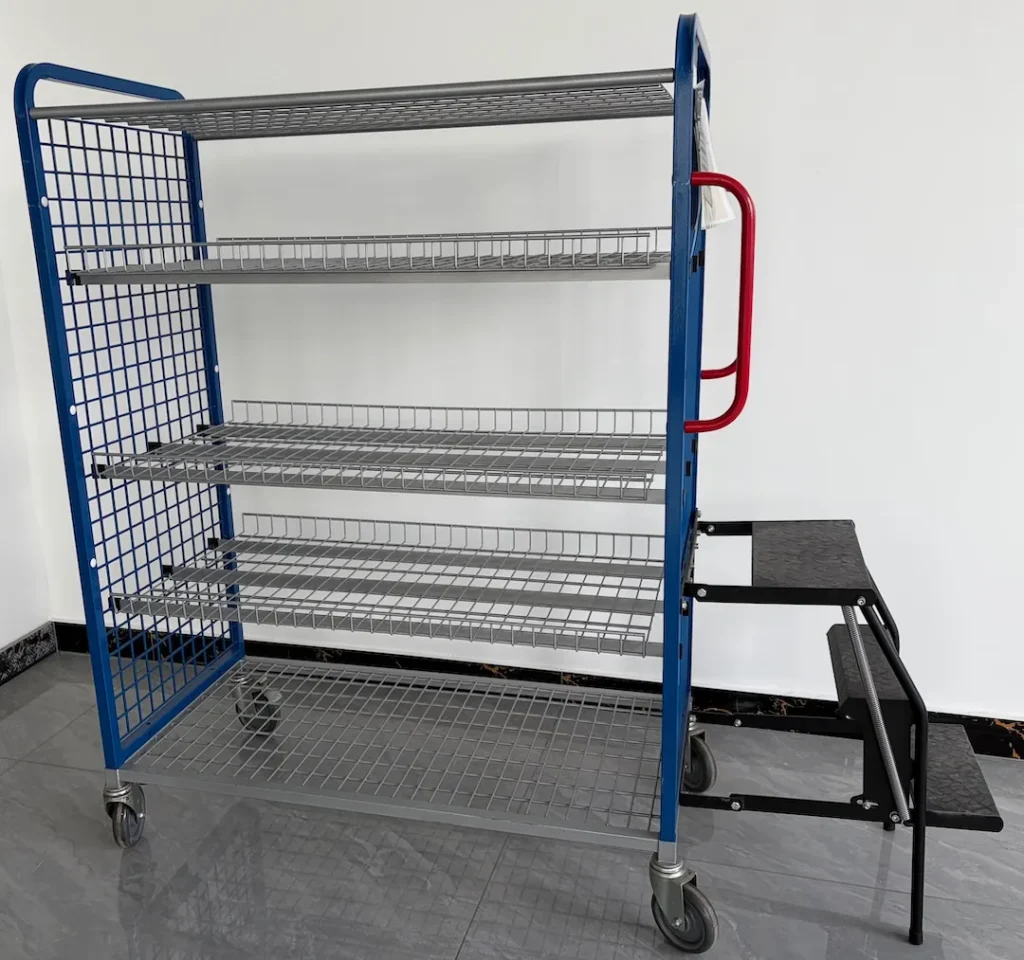
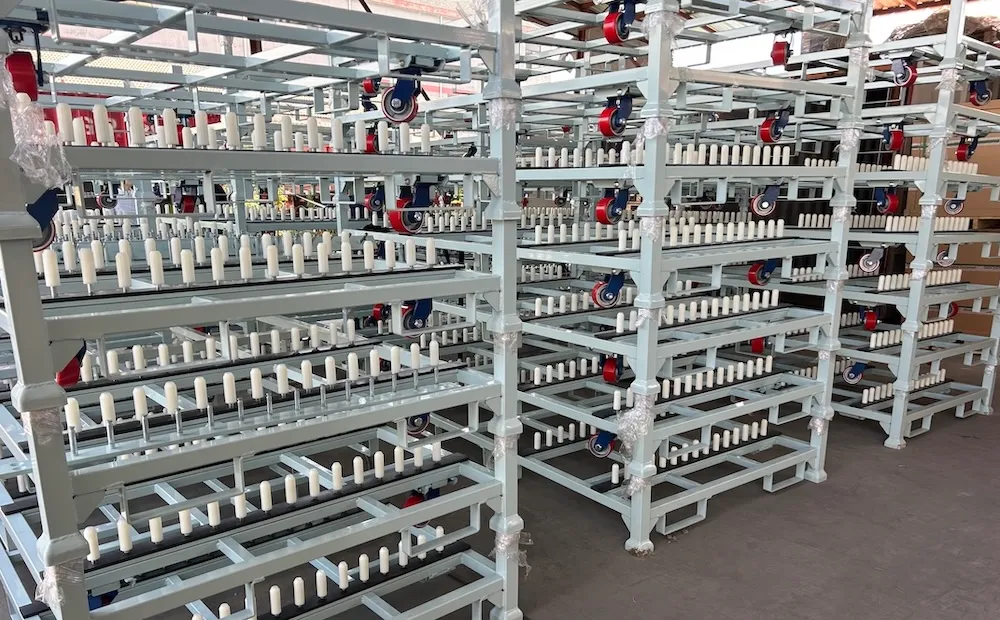
Build-to-print custom industrial carts for international OEMs
Custom industrial carts manufacturer in China versus catalog trolleys
A catalogue trolley fixes deck size and load rating; build-to-print lets your load, aisle and workstation define the cart. Sehen Industrielle Materialhandhabungswagen.
Welded cart frames, fitted casters, and complete material-handling carts
We supply bare welded frames, frames with casters fitted, or complete carts with dunnage and hardware installed.
Manual carts, industrial trolleys, and tugger carts in one OEM scope
Manual carts, tugger carts and nested fleets share one route through Kundenspezifisches Schweißen & Fertigungsdienstleistungen; powered and rail-guided vehicles are quoted separately.


Types of custom industrial carts we manufacture
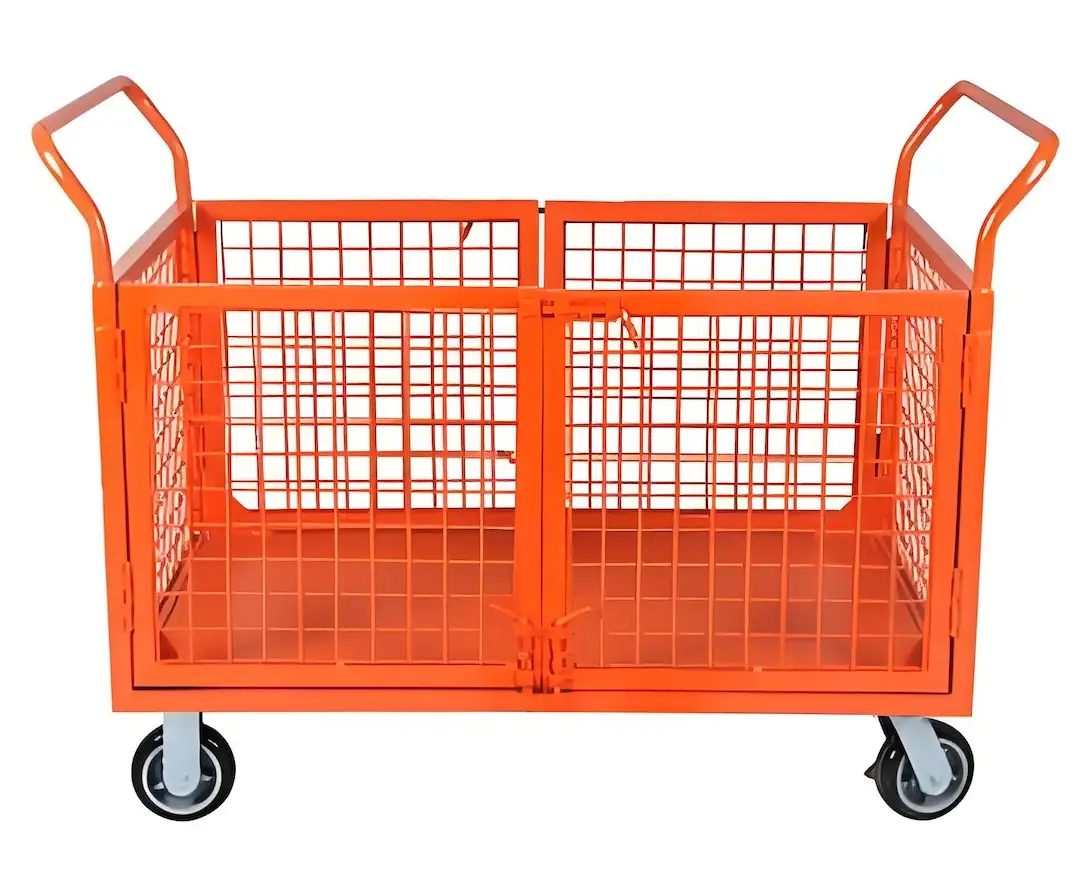
Custom platform carts and flatbed industrial trolleys
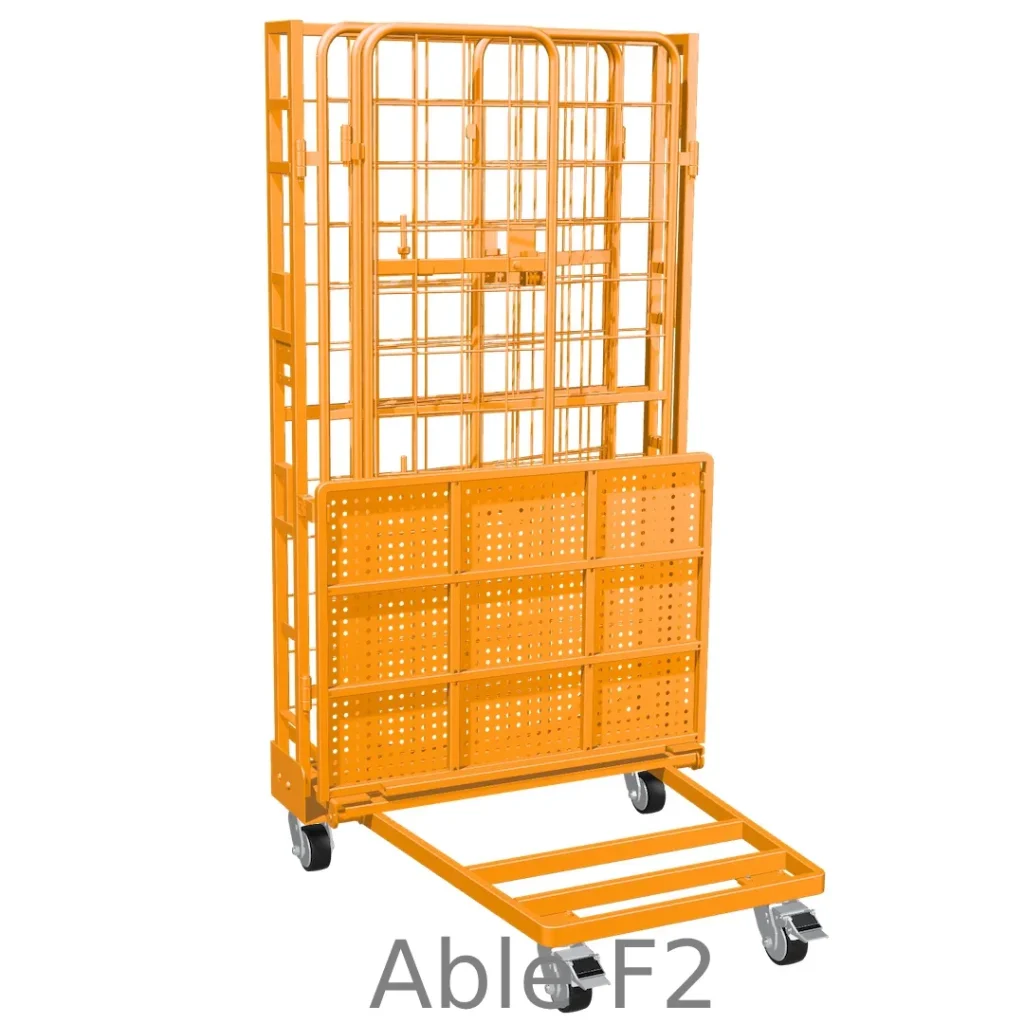
Flat decks for totes, boxes and machinery — see Kundenspezifischer Plattformwagen — while a Zusammenklappbarer Logistikwagen collapses for return freight.
Regal, tray, kit, pflücken, and WIP carts
Multi-tier carts for kitting, picking and work-in-process, with shelf pitch set by part geometry. Sehen Bestückung von Kommissionierwagen.
Line-side, rack, cage, and security carts
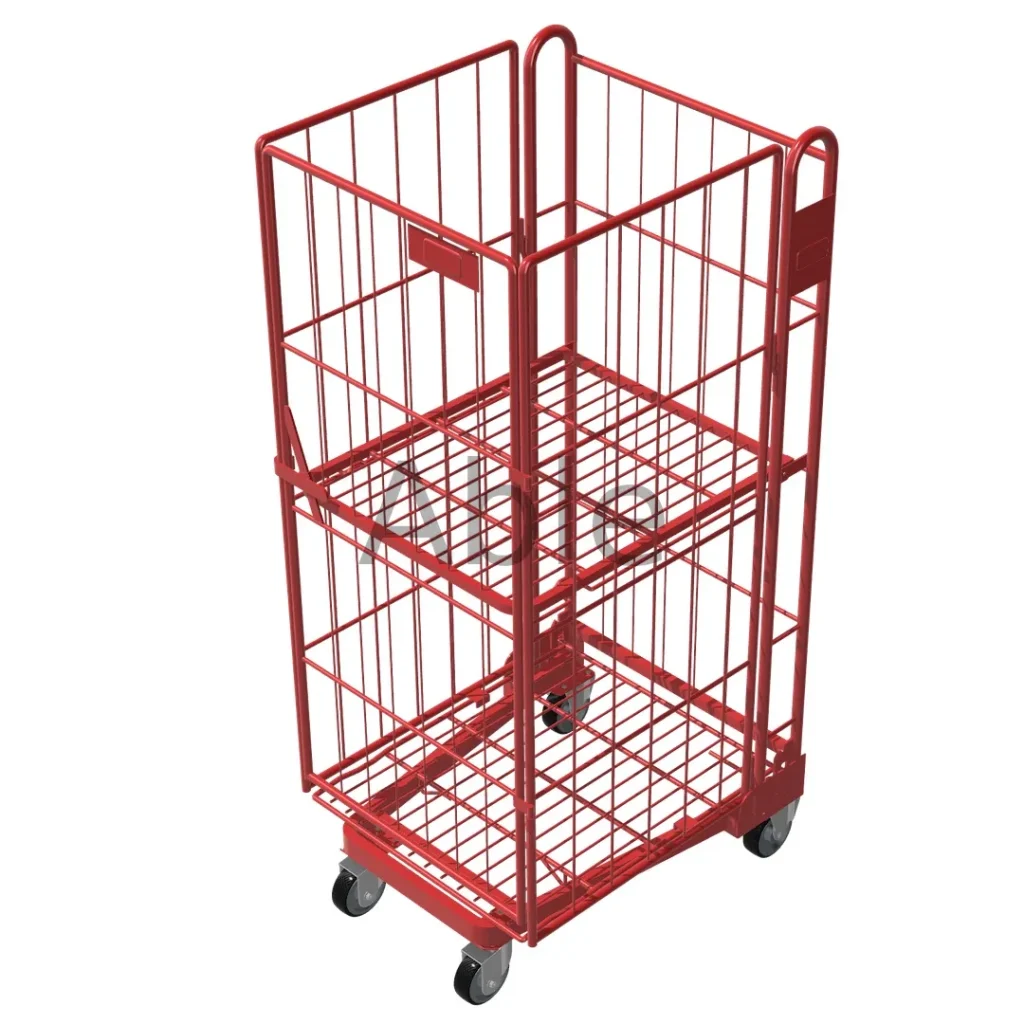
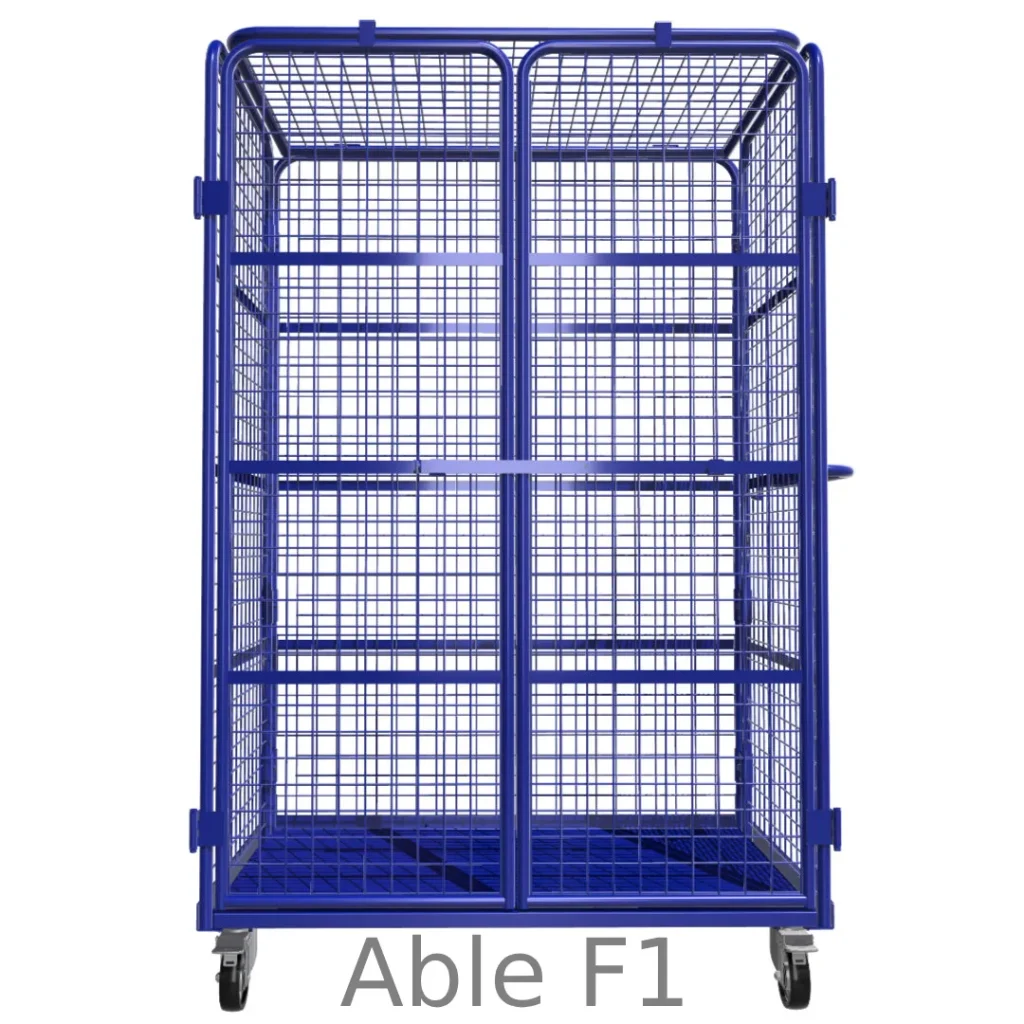
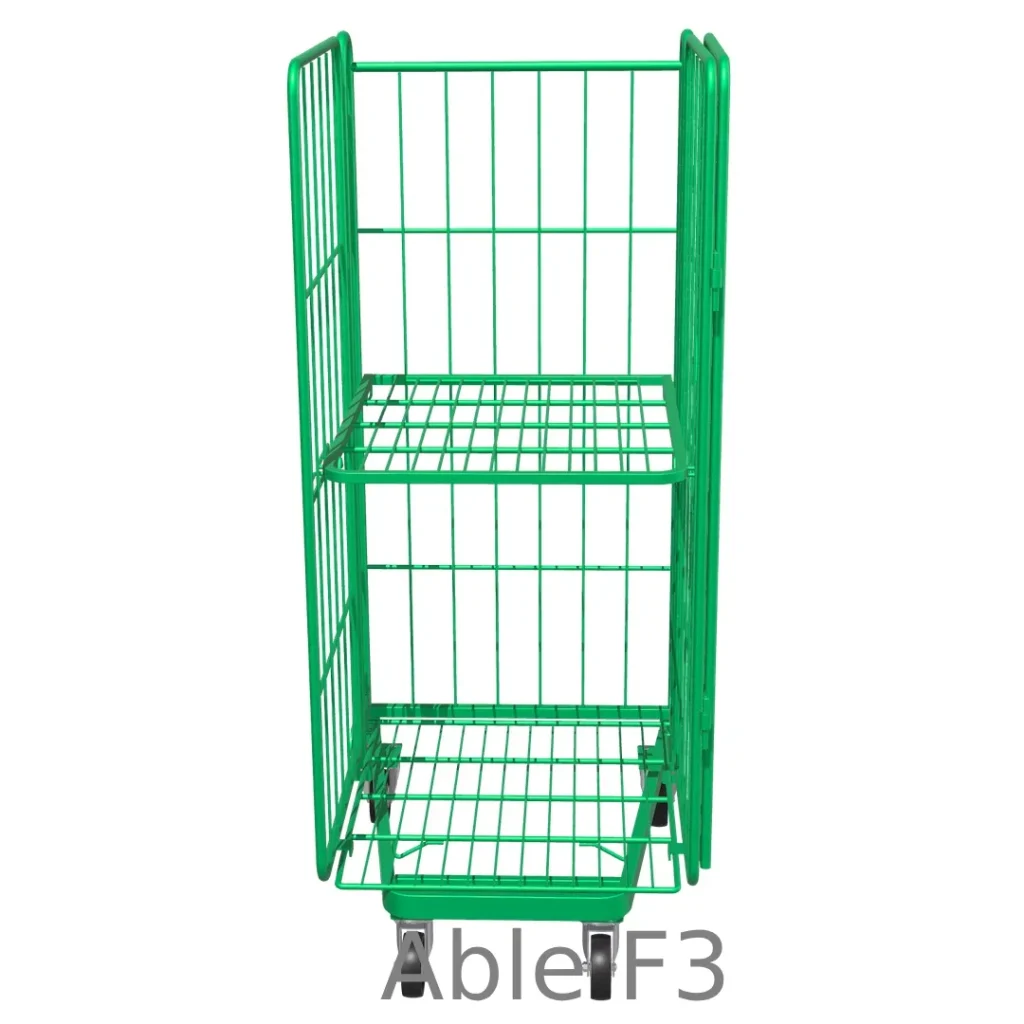
Enclosed stock control using Logistischer Rollkäfigwagen units and Rollwagen aus Drahtgeflecht builds with hinged gates and lockable doors.
Werkzeuge, fixture, Schimmel, die, and equipment carts
High point loads need heavier deck gauge, closer crossmember spacing and docking features matched to a bolster.
Panel, sheet, pipe, Bar, drum, coil, and roll-handling carts
A-frames, Wiegen, chocks and edge protection, where retention matters more than deck area.
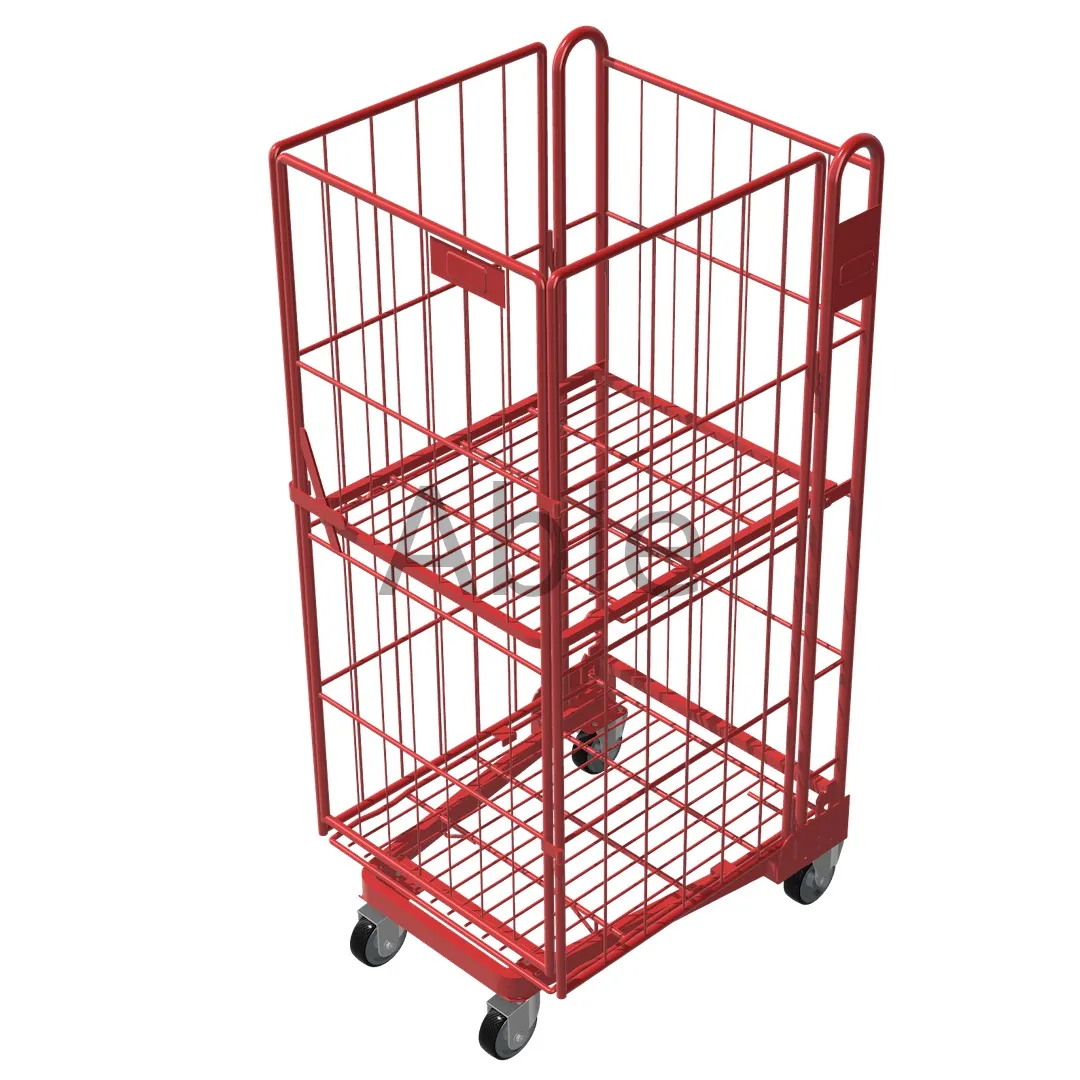

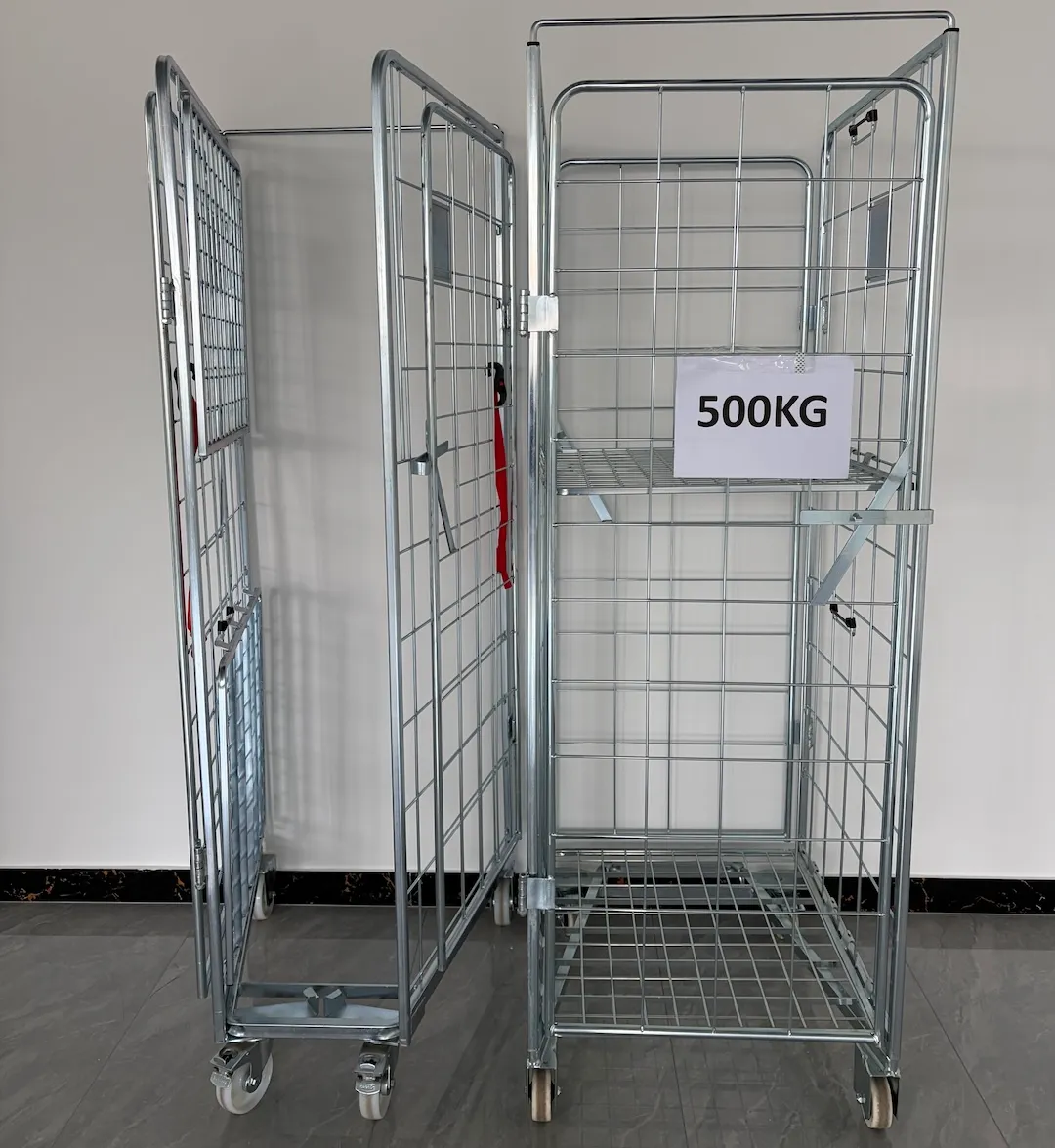
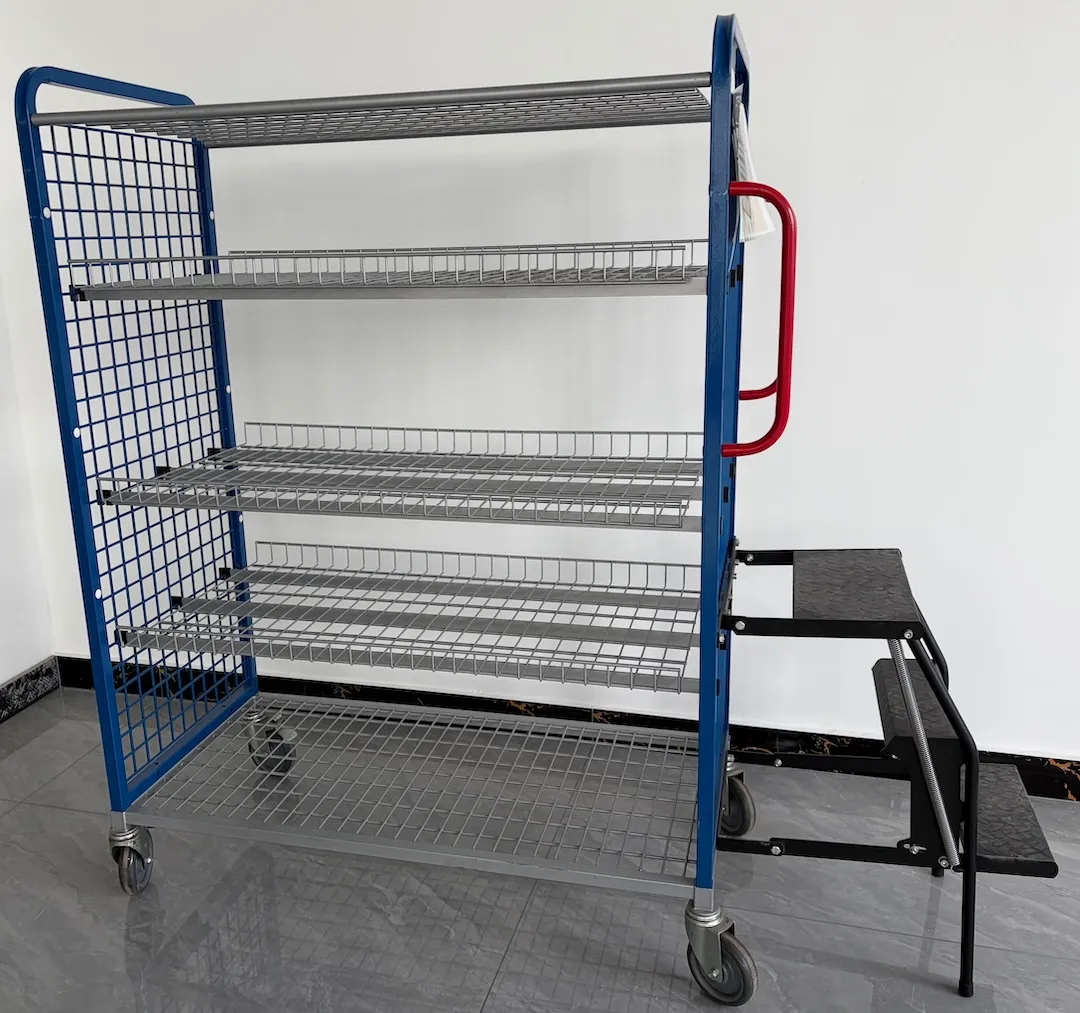

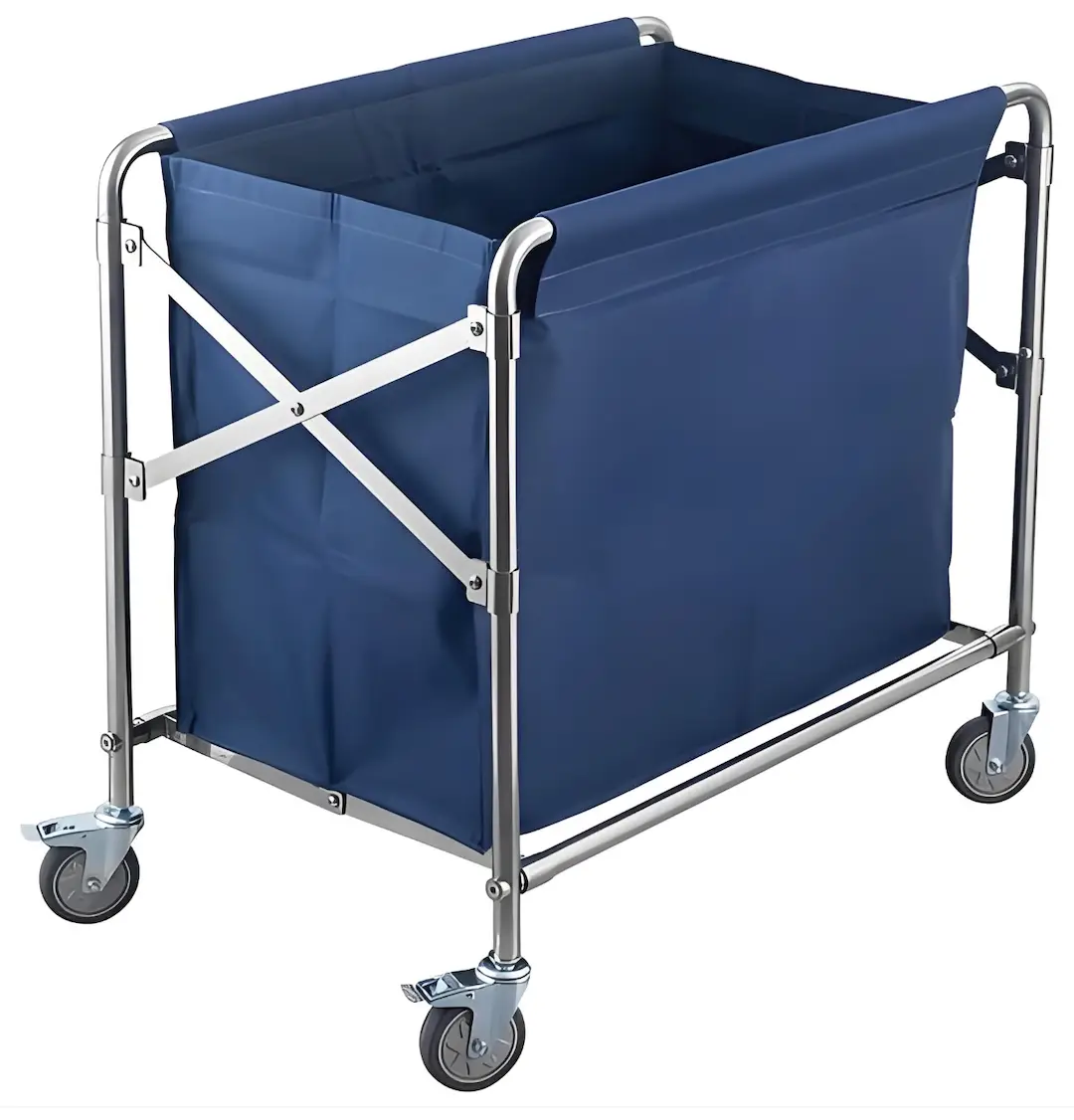
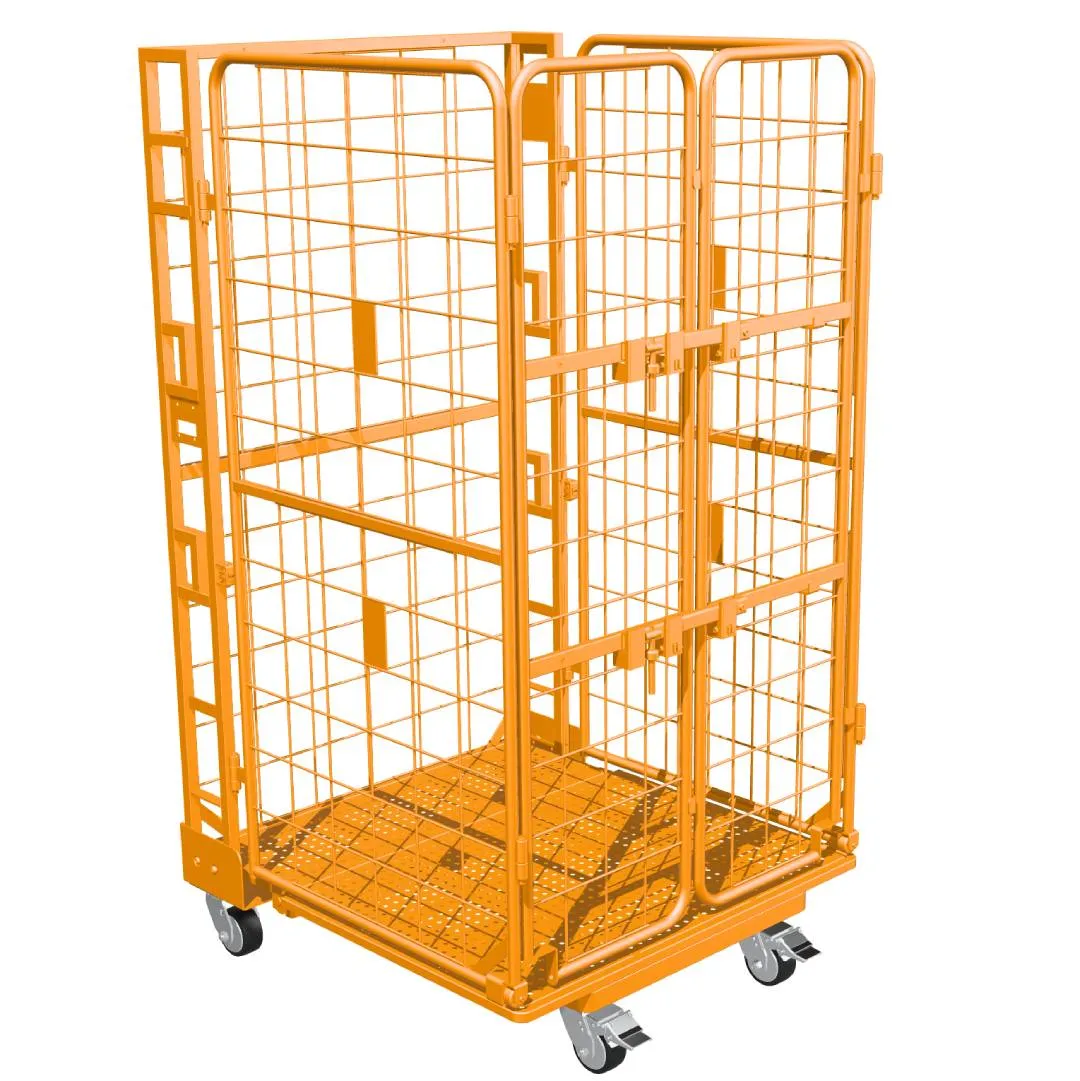
Design your cart around the load, Route, and workstation
Payload, tare mass, Schwerpunkt, and load distribution
Quote accuracy starts with payload, tare and gross mass: 600 kg on two pads is not 600 kg across a deck.
Aisle width, Türfreiheit, turning envelope, and transfer height
Send narrowest aisle, smallest door and tightest turn; a 50 mm deck-height mismatch turns a slide into a lift.
Floor type, joints, Schwellenwerte, gradient, und Arbeitszyklus
Floor condition drives wheel diameter more than payload does; trips per shift set bearing and tread duty.
Loading by hand, forklift, crane, conveyor, or lift table
Forklift loading needs fork pockets, crane loading verified lift points, and lift-table transfer matched deck height.
Plattform, Regal, rack, cage, and load-specific cart designs
Decks, lips, Regale, gravity-flow trays, and adjustable levels
Decks come in plain plate, chequer plate, perforated sheet, expanded metal or mesh, plus sloped gravity trays.
Stauholz, nests, pins, Trennwände, and part-protection interfaces
Nests, pins, foam and inserts prevent part damage and stay replaceable, so wear items never scrap a frame.
Mesh cages, lockable doors, and inventory-control carts
Mesh sides restrain loose stock while keeping visibility, with drop gates and padlock provisions for high-value stock.
Nested, stapelbar, and knock-down cart constructions
Nisten, stacking posts and knock-down uprights cut return freight volume, but must be designed in early.


Rollen, wheels, steering, Bremsen, and handle options
Two rigid and two swivel, four-swivel, six-wheel, and directional-lock layouts
Two rigid plus two swivel tracks straight, four swivel casters manoeuvre in place, six-wheel patterns pivot tightly.
Polyurethane, Gummi, Nylon, phenolic, non-marking, and conductive wheels
Polyurethane suits most concrete plants, rubber cuts noise, and nylon or phenolic carry more load at higher force.
Wheel brakes, total-lock casters, central brakes, and parking brakes
A swivel lock is not a wheel brake, and neither reliably holds on a gradient. Total-lock casters hold both.
Push handles, pull handles, handle height, and operator clearance
Push handles typically sit near 900–1,100 mm; IN 1757:2022 references drawbar heights of 700–1,000 mm towing, 1,100–1,300 mm pushing.
ISO 22883, ISO 22884, IN 12532, and ANSI ICWM caster selection
ISO 22883 and EN 12532 cover manual or towed use to 1.1 MS (4 km/h), ISO 22884 zu 4.4 MS, und ISO 22878 defines test methods. ANSI ICWM-2018 rates casters by endurance testing — static load at four times rating for one minute — so cart capacity is never simple arithmetic.
Custom tugger carts and mother/daughter systems
Towable industrial carts compatible with existing tuggers
Most tugger programs are retrofits, so send your tractor model and hitch drawing. Sehen Kundenspezifische Routenwagen.
Deichsel, hitch, tow height, articulation, and safety retention
Define coupler type, loaded tow height, articulation, secondary retention and drawbar stowage.
Center-steer, quad-steer, and train-tracking cart geometries
Center-steer carts pivot around a central axle; quad-steer geometry keeps each cart nearer the tractor path.
Mother carts, daughter carts, and line-side exchange interfaces
Mother frames carry detachable daughter carts, so capture and latch dimensions are fixtured for fleet interchangeability.
Tow-train swept path, off-tracking, and maximum train mass
A loaded route trial records swept path, off-tracking by position and train mass against rated drawbar pull.
Payload, Stabilität, Ablenkung, and caster-load engineering
Complete-cart rated capacity versus caster catalogue ratings
Four casters rated 500 kg each do not make a 2,000 kg cart; the weakest element governs.
Rahmen, Deck, axle, Verschluss, Bremse, and stability limiters
Deck gauge, crossmember spacing, frame sections, caster plates, Verbindungselemente, brakes and stability are checked separately.
Point-load, offset-load, and high center-of-gravity cases
IN 1757:2022 verification includes static tilt testing near 36% longitudinal and 23% lateral unladen, 18% at rated load, plus a 20 mm obstacle impact.
Deck deflection, permanent set, and proof-load validation
Proof-load results should state loading pattern, deflection and residual set; deck sag also raises push force.
Uneven-floor wheel sharing and dynamic route loads
Sizing on three of four wheels is standard, so a 400 kg gross cart needs roughly 135 kg per caster.
Ergonomic push-pull force measurement
Initial, sustained, drehen, and breakaway force under defined floors
Report peak starting force and sustained rolling force, with load, floor and wheel specification stated.
ISO 11228-2 pushing and pulling assessment conditions
ISO 11228-2 and Amendment 1:2022 assess pushing and pulling by force, frequency, distance and posture, not one universal limit.
Griffhöhe, wheel diameter, and low rolling-resistance options
Larger wheels and softer tread lower starting force; IN 1757:2022 limits run near 200 N to start and 100 N to keep a 500 kg truck rolling.
Height-adjustable, Schieflage, rotate, and lift-assist carts after safety review
Tilt, rotate and lift-assist carts remove bending but add trapping points, so a documented risk review applies.
Stahl, rostfreier Stahl, Aluminium, and ESD cart options
Carbon steel and Q355 heavy-duty industrial cart frames
Q235B offers roughly 235 MPa minimum yield against 355 MPa for Q355B, often allowing thinner walls and lower tare. Sehen Kundenspezifische Metallschweißdienste.
304, 304L, and 316L stainless washdown and cleanable carts
Washdown duty uses 304, 304L or 316L via Schweißdienstleistungen für Edelstahl; textile and hospitality fleets appear under Kundenspezifische Wäschewagen.
Lightweight aluminum industrial carts and mixed-material constructions
Aluminium cuts tare mass at higher deflection for the same section — see Aluminiumschweißdienstleistungen.
Conductive casters, bonding paths, and surface-resistance tested ESD carts
ESD carts need a continuous path from load surface to floor, commonly specified in the 10⁵–10⁹ Ω band.
Pulverbeschichtung, Verzinkung, Passivierung, and washdown design
Pulvermantel, nasse Farbe, E-Coat, and zinc plating for steel carts
Powder coating suits indoor fleets, wet paint suits oversized frames, and zinc plating protects hardware — see Metalloberflächenbehandlung.
Hot-dip galvanizing, venting, drainage, and outdoor corrosion protection
Outdoor service moves toward hot-dip galvanizing or an ISO 12944 System, with vent and drain holes designed in.
Passivierung, electropolish, and crevice control for stainless trolleys
Stainless cleanability depends on weld profile and crevice design; pickling and passivation restore the passive layer.
Masking of caster mounts, Threads, Bremsen, and grounding points
Caster faces, Klopflöcher, brakes and bonding points are masked so hardware seats flat and ESD paths stay conductive.
Verified cart capacity and production performance
Stage-by-stage cart envelope, mass, and coating limits
Maximum cart size is set by the smallest stage: fixture, Bearbeitung, coating booth, crate or container.
Measured payload, push-force, Ausrichtung, and interchangeability cases
Useful evidence is measured: payload with deflection, push force on a stated floor, and cross-mating trials.
Quote response, first-pass yield, on-time delivery, and warranty metrics
Every percentage needs a period, denominator and definition before suppliers can be compared; sehen Qualitätskontrolle.
In-house versus approved-partner process disclosure
We disclose in-house operations, einschließlich Laserschneiddienstleistungen und CNC-Bearbeitung & Schweißdienstleistungen, and which processes use approved partners.
Custom industrial carts by industry and application
Automobil, EV, and line-side kitting carts
High-cycle kitting, sequencing and battery-module carts, usually as controlled fleets with interchangeable interfaces.
Maschinen, Werkzeuge, warehouse, and logistics trolleys
Tooling carts for machine shops plus picking, roll-cage and platform fleets, alongside Kundenspezifische Schweißbaugruppen und Kundenspezifische geschweißte Rahmen.
Electronics ESD, stainless food-equipment, and clean-area carts
Reel and circulation carts with defined resistance paths, plus stainless carts for food and controlled areas.
Aerospace tooling, energy, battery, and maintenance carts
Protected-component tooling carts, battery-handling carts, and MRO carts with drawers and security hardware.
How to evaluate a custom industrial cart manufacturer in China
Laden, Route, caster, hitch, and test-capability checks
Ask how load and route data become a caster and frame specification, and which tests run in-house.
Fixture, Ausrichtung, Fai, and complete-cart payload evidence
Request a first-article report with measured values and the calculation behind the payload plate.
Fleet interchangeability, spare parts, and export packaging proof
For fleets, confirm cross-mating results, replacement part numbers and carts per crate and per 40 ft container.
RFQ files: drawings, Nutzlast, floor data, tugger interface, und Menge
Send drawings or STEP files, Nutzlast, floor data, tugger interfaces, finish and quantities; detail parts fall under OEM-Schweißblechteile.
FAQ about Custom Industrial Carts
Welche Tragfähigkeit sollte ich für meinen Anwendungsfall angeben?
Geben Sie sowohl statische als auch dynamische Erwartungen an, plus, ob die Lasten gleichmäßig oder punktuell sind. Wenn Sie unsicher sind, Teilen Sie uns den Nutzlasttyp und das maximale Gewicht mit und wir schlagen Ihnen eine sichere Bewertung vor.
Sollte ich mich für einen Überrollkäfig entscheiden?, Kommissionierung, Falten, oder Flachbett
Überrollkäfig unterstützt sichere Logistik, Kommissionierwagen optimieren die Nachschubgeschwindigkeit, Faltkonstruktionen reduzieren Lager- und Frachtkosten, und Pritschenwagen bewältigen sperrige Lasten mit einfachem Ladezugang.
Was ist die beste Rollenkonfiguration für enge Gänge?
Vier Lenkrollen maximieren die Manövrierfähigkeit, während 2 starr + 2 Der Drehgelenk verbessert die Spurstabilität. Die beste Wahl hängt von der Gangbreite ab, Ladegewicht, und Bedienergewohnheiten.
Wie wähle ich die richtige Oberflächenbeschaffenheit für Korrosionsbeständigkeit aus?
Pulverbeschichtung eignet sich gut für den Innenbereich; Ein zinkbasierter Schutz oder Edelstahl kann bei höherer Korrosionsbelastung besser sein. Teilen Sie die Umgebung und wir empfehlen Ihnen Optionen.
Können Sie unser bestehendes Warenkorbdesign und Branding anpassen?
Ja. Wir können Kerngeometrie und Funktionsmerkmale aufeinander abstimmen und Markenschilder hinzufügen, Farben, und Identifikationsmerkmale für Flottenkonsistenz.
Request a custom industrial cart quote
Send drawings, or describe the load, route and workstation. Our engineers return manufacturability feedback, caster and payload recommendations, and pricing with cost drivers identified. Add destination port and Incoterm — FOB, CIF or DDP — for landed-cost comparison. Contact Able Hardware in Suzhou.
Fordern Sie ein Angebot an
Mehr Kundenspezifische Industriewagen: